
Expense Report Template
An expense report should be quick to fill in and easy for a manager to approve. Add each expense and mileage trip, and this template totals everything by category, subtracts any advance, flags missing receipts and produces a printable report with signature lines — all in your browser.
- Free to use
- No sign-up
- Runs in your browser
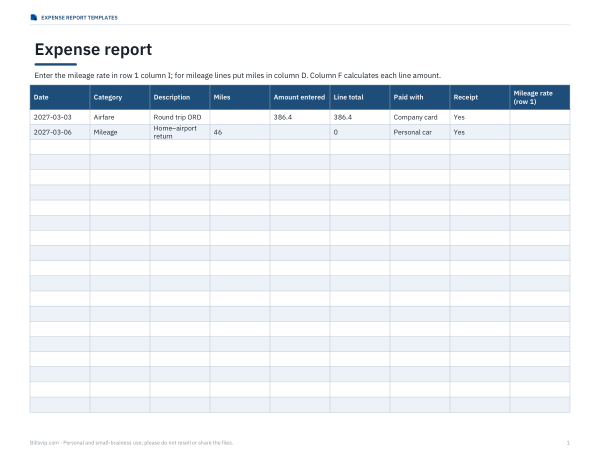
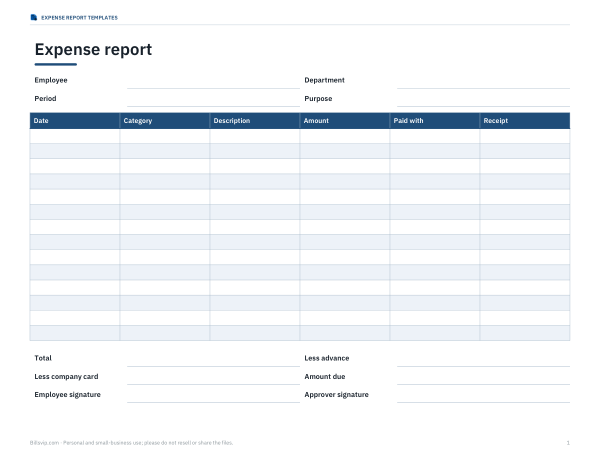
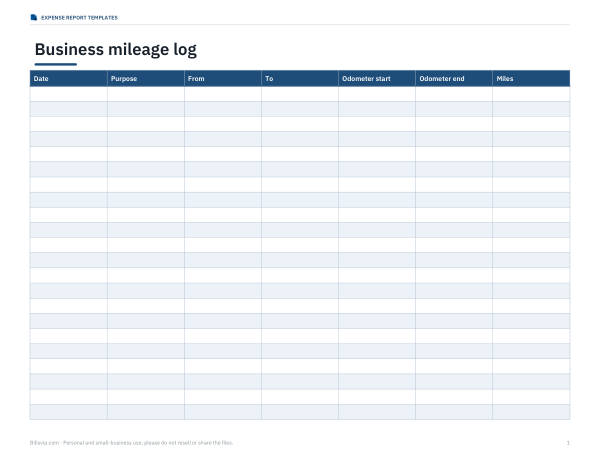
Expense report
Expense Report Templates
Excel expense report with automatic mileage, category totals and advances, a printable expense report form, a mileage log, a receipt checklist sheet and a travel expense policy starter template.
- Expense report (XLSX)
- Printable form (PDF/DOCX)
- Mileage log (PDF/DOCX/XLSX)
- Receipt checklist (PDF/DOCX)
- Policy starter (DOCX/PDF)
Formats: XLSX, PDF, DOCX. Instant download after payment (link valid 72 hours, up to 5 downloads). AI-assisted: the templates were drafted with AI help and reviewed and laid out before publishing.
$5.00 USD, one-time 5 files · about $1.00 each
- Instant download
- 7-day refund
- Secure checkout by Stripe
7-day money-back guarantee. Full refund within 7 days of purchase, even after you download.
Free sample: Expense Policy Starter (PDF, 58 KB)
Full refund within 7 days — see the refund policy and license.
Free printables
Single sheets you can print right now, no sign-up. The full pack adds every sheet in one download plus the editable files.
 Printable Receipt Checklist
 Travel and Expense Policy Template
What an expense report includes
| Section | Details |
|---|---|
| Header | Employee name, department or project, reporting period, purpose of the trip or expenses |
| Line items | Date, category, description, amount, payment method and whether a receipt is attached |
| Mileage | Trips with start, end and miles, at your organisation’s rate |
| Totals | By category and overall |
| Adjustments | Company-card charges, cash advances and personal items |
| Approval | Employee and approver signatures and dates |
Keep descriptions specific — “Dinner with Acme buyers (3 people)” is much easier to approve than “meal”.
Worked example
After a trade show, an employee enters a $386.40 flight paid on the company card, a $537 hotel and a $142.75 client dinner on a personal card, a $28.50 taxi without a receipt, and a 46-mile round trip to the airport. With the organisation’s mileage rate entered, the report totals the expenses by category, subtracts the flight already paid by the company card and the $200 cash advance, and shows the balance owed to the employee — while flagging the taxi as missing a receipt so they can add an explanation or a card statement.
Mileage reimbursement
Organisations set their own mileage rate. In the US, many use the IRS standard mileage rate, which the IRS updates each year — enter the current rate your organisation uses. Record the date, purpose, start and end points and miles for each trip; many policies exclude normal commuting between home and your regular workplace.
Receipts and policy
- Attach itemised receipts for each expense, as your policy requires.
- Many organisations set a receipt threshold, per-diem meal limits and approved categories.
- Alcohol, personal items and upgrades are often not reimbursable — check your policy.
- Submit reports promptly; some policies have deadlines such as 30 or 60 days.
- Keep copies of everything you submit.
Per diem vs actual expenses
| Method | How it works | Receipts |
|---|---|---|
| Actual expenses | Reimburse what was spent, within limits | Required for each item |
| Per diem | A fixed daily allowance for meals and incidentals (sometimes lodging) | Often only proof of travel dates |
| Hybrid | Actual lodging plus per-diem meals | Lodging receipts only |
US federal per-diem rates are published by the General Services Administration and vary by city and season; many private organisations use them as a guide.
Common expense categories explained
| Category | Typical items | Watch for |
|---|---|---|
| Airfare | Tickets, change fees, seat fees if allowed | Class of travel limits; book early |
| Lodging | Room rate and taxes | Room service, minibar and movies are often personal |
| Meals | Own meals while travelling, business meals | List attendees and purpose; tips usually included |
| Mileage | Business use of a personal vehicle | Rate covers fuel and wear — don’t also claim fuel |
| Ground transport | Taxis, rideshare, trains, rental cars | Rental fuel and insurance rules vary |
| Parking & tolls | Airport parking, tolls, meters | Usually claimable on top of mileage |
| Supplies | Small items bought for work | Larger purchases may need pre-approval |
| Conference fees | Registration, workshops | Often paid in advance by the company |
If your organisation uses general-ledger codes, add them in the description or in the pack’s Excel workbook so finance can post the report quickly.
Foreign currency expenses
When you pay in another currency, record the original amount and currency, then convert it to your reporting currency. Most policies accept the rate shown on your card statement — which already includes any foreign transaction fee — or a published daily rate for the transaction date. Note the rate you used in the description, for example “€84.20 at 1.09 = $91.78”, so the approver can check it. For cash, keep the exchange receipt from the bureau or ATM.
Lost or missing receipts
Receipts go missing. Most organisations accept a signed missing-receipt statement that gives the date, vendor, amount, business purpose and why the receipt is unavailable, often backed by a card statement line. Some limit how often this can be used, or cap the amount. The tool flags every expense without a receipt so you can deal with it before submitting rather than having the report sent back.
Tips for faster approval
- Group expenses by trip or project.
- Photograph receipts immediately and name the files by date and vendor.
- Explain anything unusual in the description.
- Separate personal charges on the same bill.
- Double-check the totals against card statements.
What’s in the template pack
- Excel expense report with formulas for mileage, category totals and advances
- Printable expense report form
- Mileage log
- Receipt envelope / checklist sheet
- Travel expense policy starter template for small businesses
The online template is free; the pack is a one-time download.
Privacy
Everything you enter stays in your browser.
Frequently asked questions
What should be on an expense report?
Employee details, dated line items with categories and amounts, receipts, totals, advances and approval signatures.
How do I calculate mileage reimbursement?
Miles × your organisation’s rate per mile.
What is a cash advance?
Money given before a trip; it’s subtracted from the total owed.
Do I need receipts for everything?
It depends on your policy; many require itemised receipts above a set amount.
What is a per diem?
A fixed daily allowance for meals and incidentals instead of actual costs.
How do I handle expenses in another currency?
Record the original amount and currency, convert at the rate on your card statement or a published daily rate, and note the rate used.
What if I lose a receipt?
Most organisations accept a signed missing-receipt statement, often with a card statement line as backup.
Can I claim fuel as well as mileage?
Usually not — the mileage rate is meant to cover fuel, maintenance and wear.
Who approves an expense report?
Typically your manager, then finance or accounts payable checks it against the policy.
Is my data saved?
No. Download the CSV or print the report to keep it.